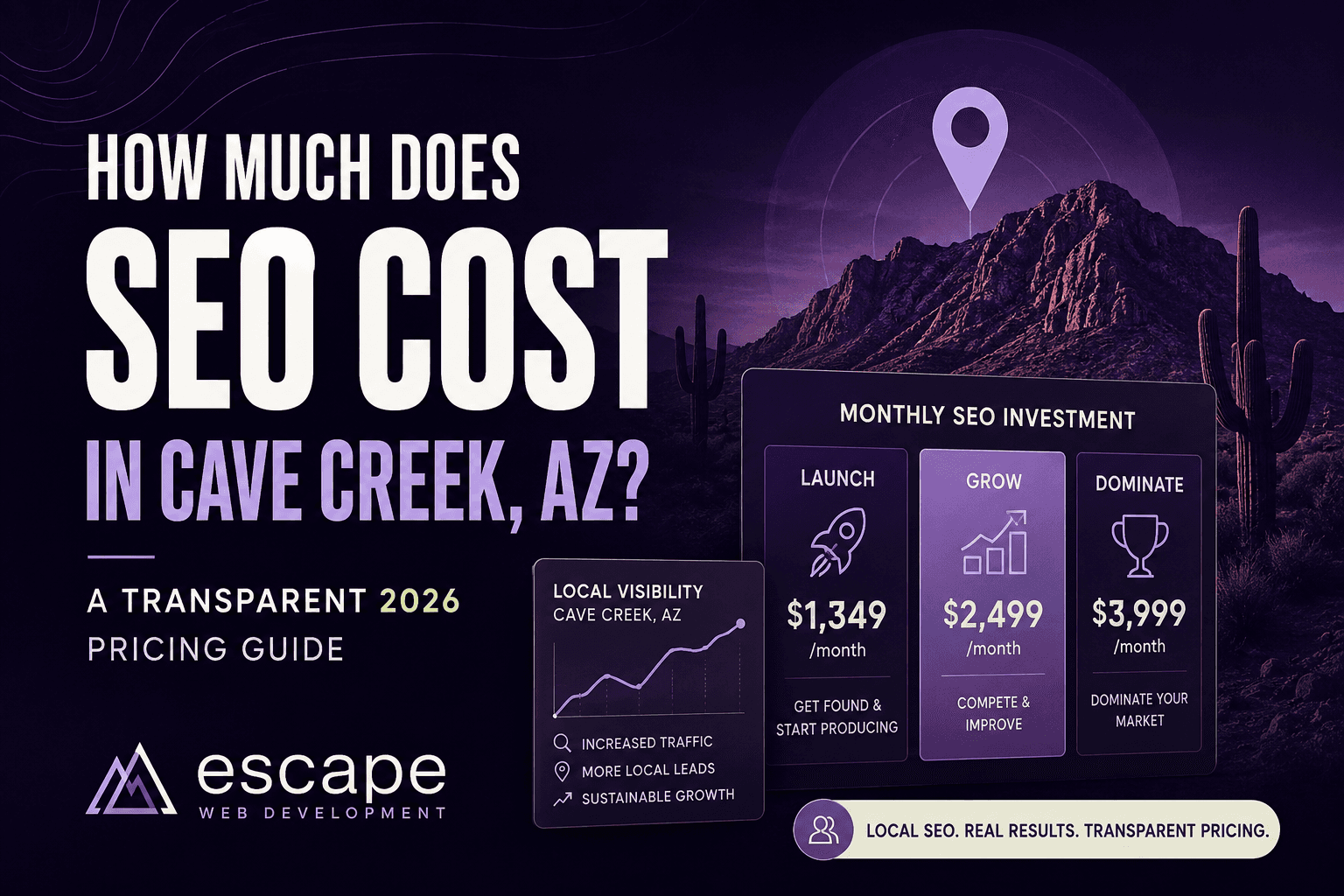
How Much Does SEO Cost in Cave Creek, AZ? A Transparent 2026 Pricing Guide
By [FOUNDER NAME], Escape Web Development · Last updated July 26, 2026
Hiring an SEO agency in Cave Creek costs $750 to $2,500 per month for most local businesses. Phoenix-metro agency minimums start closer to $1,500 to $3,200, and hourly help runs $100 to $150. At Escape Web Development, our retainers are $1,349, $2,499, and $3,999 per month.
We publish those numbers on purpose. When a company tells you to "contact us for a custom quote," the price usually depends on what they think you'll pay. It should depend on what the work costs.
And out here, the cost of SEO comes down to one question almost nobody thinks to ask you: how far past Cave Creek do you actually need to be found? A town of roughly 5,200 people spread across 38 square miles of desert changes that math in ways a national pricing guide will never tell you.
How much does SEO cost in Cave Creek, AZ?
SEO in Cave Creek costs $750 to $2,500 per month for a typical local business. That's the honest middle of the market, though the cost of SEO climbs quickly once you start reaching past the town line.
What you're buying | Typical monthly cost |
|---|---|
Tight local radius (Cave Creek, Carefree) | $800 – $1,500 |
North Valley reach (adding North Scottsdale, Anthem, Desert Hills, New River) | $1,500 – $2,500 |
Valley-wide (Phoenix, Scottsdale, Mesa, greater Maricopa County) | $2,000 – $3,000 |
Statewide or national | $3,000 – $5,000+ |
Phoenix-metro agency minimum | $1,500 – $3,200 |
Local freelancer or hybrid web consultant | from ~$800/mo or ~$150/hr |
One-time audit, no ongoing work | $500 – $5,000 |
Put the first row next to the third one. Same business, same services, same quality of work, and the price roughly doubles. Geography is the only thing that changed.
The freelancer row is worth a second look too. It's the cheapest ongoing option on the table, and it usually covers less than people assume. More on that further down.
Why does Cave Creek SEO pricing depend on how far you reach?
Cave Creek SEO pricing depends on reach because there aren't enough people in town to build a business on local searches alone. That's arithmetic, not a knock on the town.
The Town of Cave Creek puts our population at about 5,238 people spread across roughly 37.9 square miles. Add Carefree next door and you're still under 10,000. Scottsdale has more than 240,000. So the number of people typing "plumber Cave Creek" into Google in a given month is genuinely small, often a few dozen searches. You could rank first for every Cave Creek term you can think of and still see a modest number of leads if your service area stops at the town line.
That works for you and against you at the same time.
The good news. Low search volume means low competition. Winning Cave Creek terms outright is realistic on a modest budget, often within a few months, because most of your local competitors are sitting on a stale website and an unclaimed Google listing.
The catch. Winning them outright might not pay the bills. So the question isn't really what SEO costs in Cave Creek. It's how far south and west you need to be found, and what that costs.
The reach ladder
Reach | What it takes | Realistic monthly budget |
|---|---|---|
Cave Creek + Carefree | A handful of service pages, steady content, clean local signals | $1,000 – $1,500 |
North Valley (North Scottsdale, Anthem, Desert Hills, New River, Tramonto) | A dedicated page per area, more content, real competitors | $1,500 – $2,500 |
Valley-wide (Phoenix, Scottsdale, Mesa, Glendale) | Many more pages, well-funded competitors, authority building | $2,500 – $4,000 |
Statewide / national | A full content operation and aggressive authority work | $4,000+ |
Climb a rung and the workload climbs with it. That's why a Cave Creek quote and a Scottsdale quote for what sounds like the same service come back as different numbers.
What does Escape Web Development charge for SEO in Cave Creek?
Escape Web Development charges $1,349, $2,499, or $3,999 per month for Cave Creek SEO. Each tier lines up with a rung on that reach ladder instead of a vague good, better, best.
$1,349/month: Get found and start producing
10 keywords tracked
4 blog posts per month
4 service pages
Schema markup and upkeep
Monthly report
Right for: a Cave Creek or Carefree business working a tight radius. The shops along Cave Creek Road, a contractor who stays in the foothills, a practice whose patients all live within fifteen minutes. Ten tracked keywords covers a focused service list in a market this size.
$2,499/month: Compete and improve
Everything above, plus:
20 keywords tracked
6 blog posts per month
6 service pages
Competitor analysis
A/B testing and entity work
Right for: pushing into North Scottsdale, Anthem, Desert Hills, and New River, where you start running into competitors who are actually investing. The extra service pages are what let you rank in areas your physical address can't reach on its own.
$3,999/month: Win in tough markets
Everything above, plus:
30 keywords tracked
10 blog posts per month
10 service pages
Priority handling for tough verticals
Right for: Valley-wide reach, or competitive trades where Phoenix and Scottsdale firms are already bidding hard on the same terms. This is the tier for a Cave Creek business that wants leads from Scottsdale and Phoenix, not just from home.
Why our floor is $1,349
Every tier includes AI search work at no extra charge. We'll get to why that matters below.
The $1,349 is a floor rather than the bottom shelf of a pricing grid. We don't offer a $399 plan. It isn't that we don't want smaller clients, since we're a small shop ourselves. It's that at $399 there's no honest version of this service. The hour math is a couple of sections down, and it isn't complicated.
What belongs in a Cave Creek SEO package?
A real SEO package covers nine things, and SEO package pricing should account for all of them rather than promising "visibility." Run this list against any quote you get, including ours. If you want the mechanics behind these line items first, What is SEO? walks through how ranking actually works.
Keyword strategy and tracking. With a number attached. In a small market, ten well-chosen terms beat a hundred vanity ones.
Service and location pages. These are your money pages. Out here they carry more weight than the blog, for reasons covered in the map pack section below.
Blog content on a stated cadence. A specific number per month, in writing.
Technical health. Speed, crawlability, Core Web Vitals, mobile usability. One local wrinkle worth knowing: according to the Town of Cave Creek, 41.5% of residents here are 65 or older. Font size and tap targets aren't cosmetic in this market. They decide whether someone calls you.
Schema markup and upkeep. Schema breaks quietly whenever a site changes, and nobody notices for months.
Entity work and internal linking. This is how search engines figure out what your business is, not just which words sit on the page.
Competitor analysis. You're outranking specific businesses, and in a market this size you can name every one of them.
AI search and citation work. Covered below, and it's the piece most quotes skip entirely.
Reporting tied to queries, positions, and revenue. Not a traffic chart with no explanation attached to it.
Google Business Profile management belongs on that list too. Ask any provider point blank whether it's included or billed separately, because it's the item most often assumed and least often written down.
Why does SEO cost so much?
SEO costs what it does because it's skilled manual work that never really finishes. Here's where the money actually goes at our entry tier.
One well-researched blog post takes three to five hours. That covers keyword and intent research, reading whatever currently ranks, writing, on-page optimization, internal linking, and schema. Four posts a month puts you at 12 to 20 hours before anyone has written a service page, run a technical check, fixed broken schema, or produced a report worth reading.
At $1,349 for that scope, the effective hourly rate lands below what a competent specialist charges. Which is exactly why a $299 "full service" plan can't be real. At that price a provider gives your account one or two hours a month, or gives it none and lets software generate the output. Hours don't appear just because the price is low.
Scottsdale and Phoenix agencies charging $3,000 to $7,500 are expensive for a completely different reason: overhead. A good chunk of a mid-market retainer goes to account managers, strategy meetings, office space, tool licenses, and margin before anyone touches your website. Those are real costs of running a thirty-person firm and we're not knocking anyone for having them. But it does mean a small team can deliver the same output for less. There are two of us, an engineer and an analyst, with no account-manager layer to fund. That's most of the reason our top tier lands under where a lot of metro agencies start.
What drives the cost of SEO up or down in Cave Creek?
Five things drive the cost of SEO here, roughly in order of how much they matter. When we put a quote together for a North Valley business, these are the questions we're really answering.
1. How far you reach
Already covered, and it dwarfs the rest. Cave Creek and Carefree only, or the whole Valley. Every rung up multiplies your pages, your content, and the number of competitors you're fighting. It's also the one factor completely under your control.
2. Competitor density, and the Scottsdale problem
What matters isn't how many competitors you have. It's how many are actively investing in search. Inside Cave Creek the answer is usually very few, which is what makes local terms cheap to win.
Head south and that changes fast. Scottsdale and Phoenix firms in HVAC, roofing, and legal have been running serious budgets for years. A Cave Creek business chasing Scottsdale leads is walking into their market rather than defending its own, and the budget has to reflect that.
3. Seasonality
The North Valley runs on a seasonal calendar. Winter visitors and part-year residents push demand up from roughly October through April, and it thins out over the summer.
Two things follow from that. Search demand for a lot of services peaks months before your busy season, and SEO takes months to produce anything. So the right time to start is your slow season, which puts you in position before the season you actually care about shows up. Start in November and you're paying through your busiest months to benefit from next year.
Monsoon season runs mid-June through September and creates the opposite pattern for roofing, landscaping, and HVAC. Emergency searches spike hard and briefly. Those pages need to be ranking before the first storm, not after it.
4. Where your site starts
A brand-new domain begins with no authority and typically needs six to twelve months before anything meaningful moves. A site with some history and existing content can start moving in three to six.
And if the site itself is slow, badly structured, or built on a template that fights you, part of the early budget goes to fixing the foundation before optimization does anything at all. Sometimes the honest answer is that you need a website upgrade before you need SEO.
5. Content volume
A Cave Creek business with four services covering two towns might need 30 to 50 solid pages to cover its market properly. The same business going after the whole Valley needs several times that. Content volume scales with ambition more directly than any other cost driver.
One thing that isn't on this list: your revenue. Your budget shouldn't set your price. The work required should.
How does the Cave Creek map pack change what you should pay for?
The Cave Creek map pack rewards physical proximity more than almost anything else, and understanding that should change what you buy. It's the local factor national pricing guides never mention.
When someone searches "plumber near me" or "roofer Scottsdale," Google's map results weigh how close each business physically sits to the person searching. That proximity weighting is the single biggest way Local SEO behaves differently from ordinary organic ranking, and it's why a strategy built for a dense city misfires out here.
Cave Creek's 37.9 square miles are thinly populated, which helps you at home. Few competitors sit nearby, so a well-optimized local listing can take the map pack for Cave Creek and Carefree terms quickly and cheaply.
Going south, it works against you. A business off Cave Creek Road will struggle to appear in the map pack for someone standing in central Scottsdale, and no budget fixes that. Distance isn't something you can outspend.
So your strategy splits, and your spending should split with it. Close to home, listing optimization and reviews are the highest-leverage, lowest-cost work available. That's the cheap win, and anyone charging you a premium for it is overcharging. Everywhere past your immediate radius, the map pack mostly isn't available to you, so organic ranking is the only route left. That means service-area pages, content, and authority, which is the expensive part.
If someone quotes you Valley-wide reach and the plan is all Google Business Profile work, they've sold you something that structurally can't deliver. Ask which of your target areas they expect to win in the map pack and which through organic results. A good answer is specific to each area you named. A bad answer is "we'll improve your visibility."
Is cheap SEO worth it in Cave Creek?
Cheap SEO isn't worth it, and we'd rather say that plainly than dance around it. SEO is not a cheap endeavor, and anyone advertising it as one is lying to you.
Businesses across the North Valley get pitched $200 to $400 packages constantly, and they all work the same way. The provider puts almost no human time into your account. Output comes from automated reports and spun or AI-generated filler. Links, when there are any, come from junk networks. For three to six months you get PDFs with green arrows on them.
The wasted money is the smaller problem. Automated filler and spam links break search engine guidelines, and detection got sharply better through 2026. When it catches up with you, you don't land back at neutral. You land below where you started, with a penalized domain that takes six to eighteen months to recover and costs two or three times what doing it properly would have cost. So you pay twice. Once for the service, once for the cleanup.
There's a reliable way to spot it. Ask what specific work happens in a month. A legitimate provider names deliverables: this many pages, this much content, these keywords, these technical fixes. A cheap provider describes outcomes instead. "Improved visibility." "Increased optimization." "Enhanced online presence." None of that is a scope of work.
What does affordable SEO mean for a Cave Creek business?
Affordable SEO means the lowest price at which the work can actually be done properly, which is not the same thing as the lowest price on the market. Confusing those two is how a local owner loses a year.
In a market this size, affordable looks like transparent pricing, a scope you can audit, and a target narrow enough that your budget can genuinely win it. A Cave Creek business paying $1,349 to own Cave Creek and Carefree is buying affordable SEO. A Cave Creek business paying $299 to "target Phoenix" is buying nothing at a discount.
The most affordable move available to you usually isn't a cheaper provider. It's a narrower target. Owning Cave Creek and Carefree completely beats being invisible across Maricopa County, and it costs a fraction as much. Once your home base is producing revenue, the North Valley becomes reachable. Win the puddle first. We'd rather quote you a tighter scope at our floor than take a bigger budget for a fight you aren't ready for yet.
How does the cost of SEO compare to Google Ads?
Compared to paid advertising, the cost of SEO buys you an asset instead of renting attention. Both work. They just behave differently, and the difference compounds.
Google Ads runs $20 to $300 per click in competitive Phoenix-area categories, and every click resets to zero. Stop paying and the traffic stops that afternoon. You're also buying one position on one keyword at a time, and paying again if the same person comes back tomorrow.
Search engine optimization works the other way around. Your monthly cost stays flat while your ranking surface grows. A single well-built page can rank for dozens of related searches, and once it ranks it tends to stay there with light maintenance. Instead of paying to sit at the top for one keyword, you're building the ability to rank organically across a lot of them. Organic results also pull a higher click-through rate than sponsored ones, because plenty of people skip the ad block entirely and they know exactly which is which.
Over the long run that makes SEO more effective than Meta Ads and, in our experience, considerably better value than Google Ads for most local service businesses. Someone typing "roof repair Cave Creek" the morning after a monsoon storm is already trying to buy. Organic rankings put you in front of them without a meter running.
One thing we'll say straight: ads are faster. SEO takes six to twelve months to compound. If you need leads next Tuesday, run ads. For most seasonal North Valley businesses the strongest setup is ads for immediate volume while organic builds underneath, then easing off the ad spend as organic takes over. Paying the click meter forever is the version worth avoiding.
How do you calculate SEO ROI for a Cave Creek business?
You calculate SEO ROI from four numbers: average job value, close rate on organic leads, additional monthly leads, and your monthly cost. It takes about two minutes, and it's worth doing before you sign anything.
The formula: (average job value × close rate × additional monthly leads) − monthly cost = monthly return.
A worked example
Take a Cave Creek home-services contractor at our $1,349 tier. Average job value of $750. A conservative 35% close rate on inbound organic leads. Say the work brings in 15 additional calls a month by month six to nine.
That's 15 × 0.35, or about 5.25 jobs. Roughly $3,900 in monthly revenue against $1,349 in cost, which is just under 3x. And it keeps climbing, because the pages you paid for in month one are still working in month twenty-four.
We kept that lead number modest on purpose. Fifteen extra calls a month is a realistic target in a market this size, not an aggressive one. Anyone promising you hundreds of local leads doesn't understand the search volume out here.
Your break-even table
The simpler way to think about SEO ROI is break-even. How many extra jobs a month do you need just to cover the retainer?
Your average job value | To cover $1,349 | To cover $2,499 | To cover $3,999 |
|---|---|---|---|
$250 | 5.4 jobs | 10 jobs | 16 jobs |
$750 | 1.8 jobs | 3.3 jobs | 5.3 jobs |
$1,500 | 0.9 jobs | 1.7 jobs | 2.7 jobs |
$5,000 | 0.3 jobs | 0.5 jobs | 0.8 jobs |
$12,000 | 0.11 jobs | 0.21 jobs | 0.33 jobs |
Two caveats, both honest. These are revenue figures rather than profit, so divide by your margin for a true break-even. And they're models, not promises. Nobody can guarantee lead volume, and a provider who does is telling you something about themselves.
What matters here is the shape of the table. Cave Creek skews affluent, with a median household income around $102,589 according to the town, and that tends to push average job values up for home services, remodels, and professional practices. If a single customer is worth more than about $1,000 to you, your break-even sits at roughly one extra job a month. That's a low bar to clear. If your average job runs $250, this still works, but you'll need to target narrow and stay patient, because you're playing a volume game rather than a value game.
How long does SEO take to pay for itself?
SEO usually takes six to twelve months to pay for itself, and the curve steepens after that. Here's the realistic shape of it.
Month 1. Foundation work. Technical fixes, keyword strategy, schema, first pages built. Rankings do almost nothing. This is the month people quit.
Month 3. First movement. Long-tail and local terms start showing up in Search Console. Impressions climb before clicks do, which is normal and worth watching closely.
Month 6. Consistent inbound. Enough pages have matured that calls and form fills become predictable instead of occasional.
Month 12. Compounding. Each new page ranks faster than the last, because the domain now carries authority the early pages built.
Local terms often move faster than that in Cave Creek, simply because competition at home is thin. Terms reaching into Scottsdale and Phoenix sit at the slow end of every range.
Lay the seasonal calendar over that and the timing gets easy. If your revenue peaks between October and April, starting in late spring or summer means you're ranked when the season arrives. Start in December and you're paying through your busy season to benefit from the next one.
How do you set your SEO budget?
Set your SEO budget in three steps, in this order.
Step 1: Find your acquisition ceiling. What's a customer worth over their lifetime, and how much of that are you willing to spend to win one? For most service businesses it lands somewhere between 10 and 20%.
Step 2: Pick your rung on the reach ladder, honestly. Cave Creek and Carefree, the North Valley, or the whole Valley. Be conservative here. A tighter area you can genuinely win beats a broad one you can only sample, and this choice moves your price more than anything else on this page.
Step 3: Match the budget to the model.
Under $500/month. Don't hire anyone. Do it yourself with free tools, or wait until the budget exists. Paying someone $299 is worse than doing nothing, since doing nothing won't get you penalized.
$1,000 to $1,500/month. A serious campaign to own Cave Creek and Carefree. Where most single-location local businesses belong.
$1,500 to $2,500/month. North Valley reach, where real competitors start showing up.
$2,500 to $4,000/month. Valley-wide, or competitive trades going head to head with established Phoenix and Scottsdale firms.
Should Cave Creek businesses budget for AI search in 2026?
Yes. And for a small market like Cave Creek, AI search might be the single best value in your entire SEO budget.
Customers increasingly don't run a search and scan ten blue links anymore. They ask ChatGPT, Perplexity, or Gemini who to call, and they act on the two or three businesses named in the answer. Google's AI Overviews now sit above the organic results on a growing share of searches. Ranking fourth doesn't help much when the summary above you recommends three competitors.
Now put that in a town of 5,200 people. When someone asks an AI engine for a good roofer or electrician in Cave Creek, the model has a thin pool of local sources to pull from. In Phoenix, hundreds of businesses compete to be named. Here, a handful do, and most of them have websites that give a language model nothing worth citing.
That makes small markets the easiest place to own the AI answer right now, and the window is open mostly because almost nobody local is working on it.
Doing it well means structuring pages so a model can lift a clean answer out of them. Real questions as headers. The answer in the first sentence or two. Proper schema. Business information that matches everywhere it appears online. And content substantial enough to be worth citing in the first place, because thin pages don't get cited, and citation is the entire point.
We include this work in every tier with no upcharge, and we run a citation check every month. That means prompting ChatGPT, Perplexity, and Gemini with our clients' target questions and screenshotting whatever comes back. It's how we show the work is landing somewhere rank trackers can't see. We run it on our own site first, every month, before we run it for anybody else.
What should you ask before hiring a Cave Creek SEO company?
Ask any SEO company these five questions before you hire them. A legitimate provider answers all five without hedging.
"What specific work happens in month one?" You should get deliverables with numbers attached. If the first 30 days are all "strategy and discovery," that's usually padding.
"Which areas will I rank in through the map pack, and which through organic results?" This is the local question that separates someone who knows this market from someone running a template. A good answer is specific to each area you named.
"What's included, and what gets billed separately?" Extra articles beyond the base package run $200 to $500 each at most agencies. Technical fixes needing developer time run $500 to $5,000. Link building runs $100 to $500 per placement. Tool subscriptions get passed through. All of it commonly sits on top of a retainer that sounded complete when you signed it.
"How does your reporting connect to revenue?" A traffic chart with no explanation isn't a report. You want what changed, why it changed, and what happens next.
"What are your AI search and citation results?" In 2026, a provider who can't answer that is guessing about half of search.
Walk away from guaranteed results by a specific date, sub-$500 full-service pricing, no published pricing at all, reports that are only graphs, and early termination penalties. A provider confident in the work doesn't need to lock you in.
Frequently asked questions about SEO costs in Cave Creek
How much should I expect to pay for SEO?
Most Cave Creek businesses pay $750 to $2,500 per month. Phoenix-metro agency minimums start around $1,500 to $3,200, and hourly help averages $100 to $150. Our tiers are $1,349, $2,499, and $3,999, and which one fits depends on how far past Cave Creek you need to be found. Below roughly $500 a month there aren't enough labor hours in the budget to do the job properly.
Is SEO dead or evolving in 2026?
Evolving, and fairly dramatically. What's dying is the old version of it: keyword stuffing, bulk link buying, thin pages built purely to rank. What's replacing it is broader. You now need to be findable in traditional results, in Google's AI Overviews, and in the answers ChatGPT, Perplexity, and Gemini give when someone asks who to hire. Search didn't shrink. It split into more surfaces, and in a small market that's an opening rather than a threat.
How much does SEO cost per month?
Locally, $800 to $1,500 a month for a tight Cave Creek and Carefree radius, $1,500 to $2,500 for North Valley reach, and $2,000 to $3,000 or more for Valley-wide campaigns. Doing it yourself costs $0 to $200 in tools plus 15 to 20 hours a week of your own time. Escape sits at $1,349 to $3,999 with AI search optimization included at every tier.
Is it worth paying someone for SEO?
For most owners, yes, mainly because of the alternative. Doing it yourself takes 15 to 20 hours a week, and most businesses that start publishing their own content stop within six months. That's usually a time problem rather than a skill problem. The break-even math is forgiving here, since local job values tend to run high. If a customer is worth $1,000 or more to you, roughly one extra job a month covers a serious retainer. The real question isn't whether to pay someone. It's whether you're paying enough for the work to be real.
See where you actually stand
We'll look at where you currently rank across Cave Creek and the North Valley, what your competitors are doing, and whether AI engines mention you at all when someone asks for a business like yours. Then we'll tell you what it would realistically take to change that, including whether SEO is even the right first thing to spend on. Sometimes the honest answer is that your website needs work first, and we'll say so.
[Book a Free Call →]
Escape Web Development · escapewd.com · Web Development · SEO · AEO · Serving Cave Creek, Carefree, and the North Valley